An educational article with references listed below.
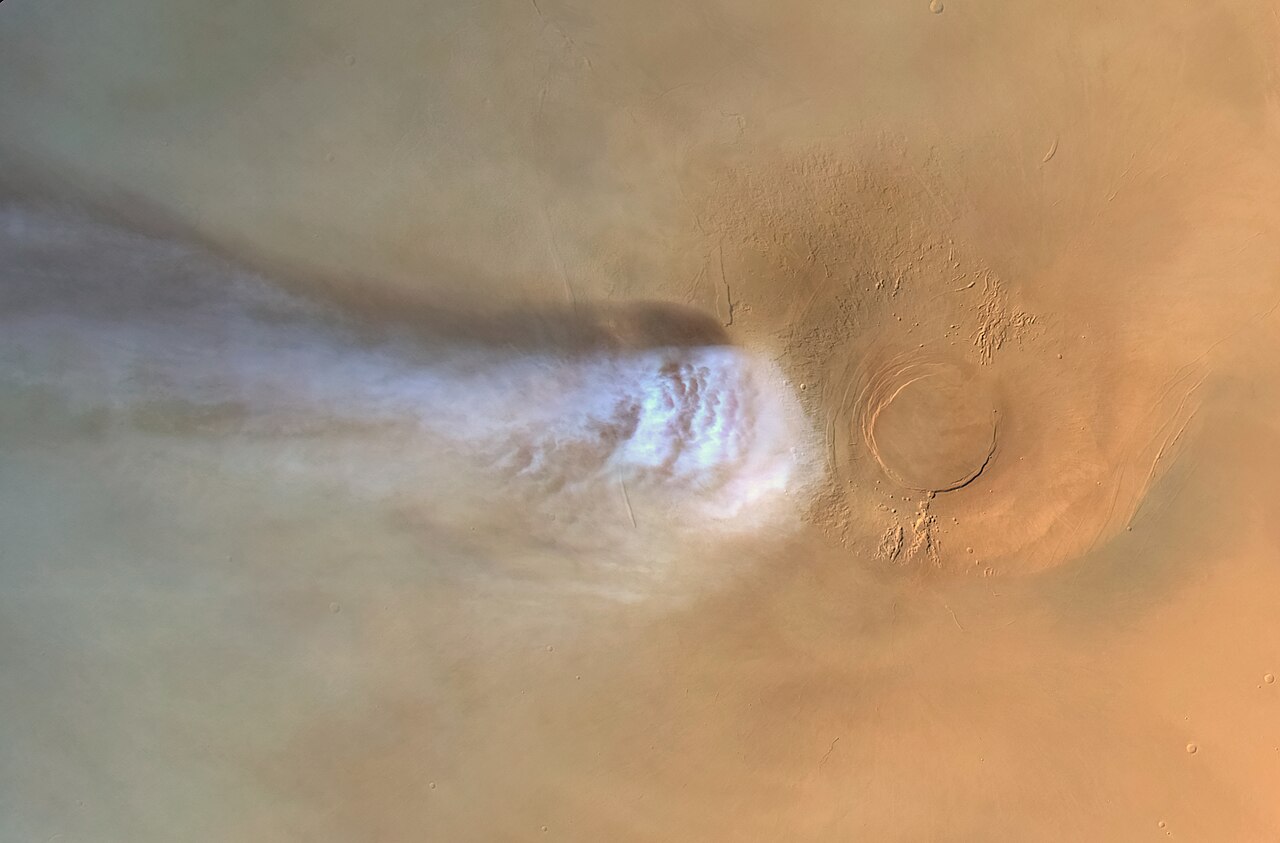
An elongated white cloud stretches across the Martian atmosphere from the Arsia Mons volcanic region. Known as the Arsia Mons Elongated Cloud, or AMEC, this phenomenon does not occur year-round. The cloud forms only during Martian spring and summer and is limited to the morning hours.
A Record of Observations Since 1977
AMEC was first recorded by NASA’s Viking Orbiter 2 spacecraft in 1977. Several decades later, the European Space Agency’s Mars Express robotic spacecraft photographed it in greater detail. The image featured in Astronomy Picture of the Day on November 2, 2026, came from observations made in 2018.
This series of observations demonstrates the importance of monitoring a planet over long periods. Atmospheric phenomena can depend on specific seasons and times of day, so they are not always visible when a spacecraft passes by or takes images. AMEC’s pattern of appearing in the morning suggests that daily changes in atmospheric conditions help determine its presence.
A Water-Ice Cloud on the Red Planet
Although it looks like smoke emerging from a volcano, AMEC is a cloud composed of water ice. After forming near Arsia Mons, winds carry the cloud material downstream. This movement produces a long tail that can stretch more than 1,500 kilometers.
Clouds form when water vapor turns into tiny droplets or crystals. On Earth, cloud crystals commonly grow around extremely small particles, including dust, which provide sites where condensation or freezing can begin. A similar process is usually the first explanation considered when scientists discover clouds in the atmosphere of another planet.
Why Its Formation Is Mysterious
That common explanation faces a problem on Mars. The planet’s upper atmosphere is too thin and lacks enough dust to support cloud-crystal formation through the best-known mechanism. The leading hypothesis currently holds that dust is probably not involved in AMEC’s formation.
However, the absence of a role for dust does not by itself explain the entire process. Scientists still need to understand how water-ice crystals begin to form, why the location near Arsia Mons is important, and why the cloud appears only during certain seasons and hours. Its extraordinary length also indicates that cloud formation and wind movement occur as a series of interconnected processes.
Mars Helps Us Understand Earth
Research into AMEC is not intended solely to explain Martian weather. The Martian atmosphere presents conditions that are very different from those on Earth, making it a natural setting for testing our understanding of cloud formation. If ice crystals can emerge without the aid of dust through another process, scientists will gain a broader picture of how clouds may behave.
Efforts to understand AMEC will continue. The knowledge gained could complement our understanding of cloud formation on Earth, particularly regarding the roles of atmospheric conditions, nucleating particles, temperature, and wind in producing different cloud structures.