An educational article with references listed below.
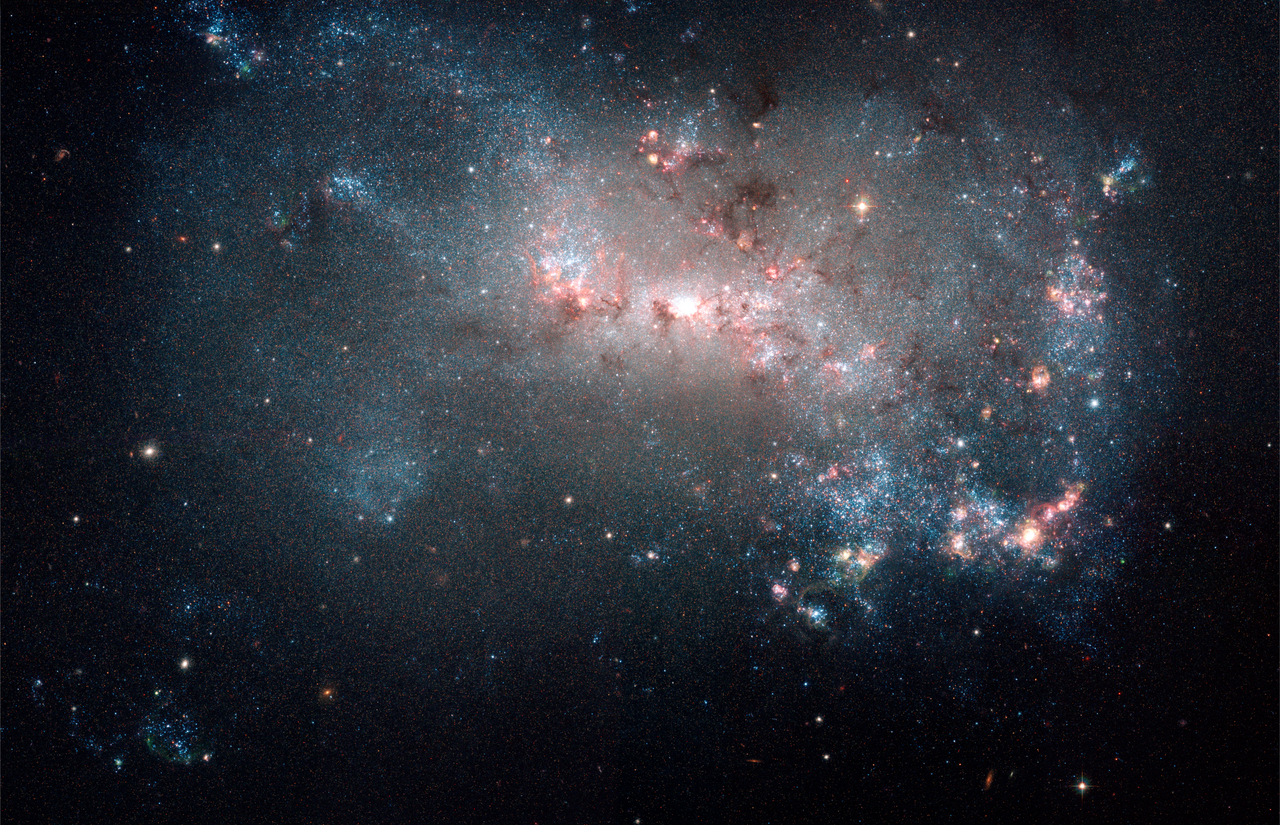
NASA's Hubble Space Telescope has revealed a chemical puzzle in our nearby cosmic environment. After studying 37 dwarf galaxies, researchers found that they contain far less oxygen than simulations predicted. The oxygen has likely not disappeared, but was instead expelled by the activity of massive stars and supernova explosions.
Why look for oxygen?
Dwarf galaxies are small galaxies that can contain anywhere from several thousand to hundreds of millions of stars. Like larger galaxies, these systems create elements through the lives and deaths of their stars. Oxygen is one of the main elements produced by stars.
Astronomers chose oxygen because it is relatively easy to detect and measure. The process by which it forms is also well understood, allowing its abundance to serve as a tracer for the distribution of various other heavy elements. In astronomy, elements heavier than hydrogen and helium are often called metals, although this meaning differs from everyday usage.
By measuring the oxygen in stars, interstellar gas, and the space outside galaxies, researchers can study how galaxies evolve and enrich the surrounding cosmic environment. Comparing the amount produced with the amount still retained also provides clues about the movement of matter throughout a galaxy's history.
Galactic winds carry matter away
Oxygen forms inside stars, so the element must once have been present within the galaxy. For matter to leave a galaxy, it requires a great deal of energy. This study shows that energy from massive stars and supernova explosions can generate galactic winds that push element-rich gas out of its host galaxy.
Dwarf galaxies have relatively weak gravitational pull because of their low mass. As a result, they have greater difficulty retaining matter accelerated by stellar explosions. Findings from the Galaxies Losing Oxygen via Winds project, or GLOW, indicate that supernova-driven winds appear to remove oxygen from low-mass galaxies more efficiently than current models predict.
The findings mean that dwarf galaxies can retain only a small fraction of the oxygen created by their stars. However, the final location of most of that oxygen remains uncertain. The element may reside in a diffuse halo of gas around the galaxies, known as the circumgalactic medium, or it may have been ejected farther into the intergalactic medium.
Reading the history of 37 galaxies
The GLOW team used Hubble's archive of optical images to observe individual stellar populations and reconstruct their star formation histories and compositions. The analysis was combined with data from the retired Spitzer Space Telescope, the Very Large Array, and the Australian Telescope Compact Array.
The 37 galaxies were selected because their masses fall within a range in which theory suggests oxygen is increasingly likely to be lost through supernova activity. The galaxies are also close enough for Hubble to distinguish their individual stars, something that cannot be done for most other dwarf galaxies because they are too distant. Using this approach, researchers traced how oxygen is distributed among stars, gas, and dust.
The next search
Future research will target galaxies with even lower masses in the nearby universe. The Nancy Grace Roman Space Telescope is expected to help discover faint, extremely small systems across wide areas of the sky. Hubble and the James Webb Space Telescope can then conduct deeper observations of their stars to reconstruct their formation histories across cosmic time.
Hubble observations will also focus on individual massive stars that produce oxygen and help expel it. These detailed studies are expected to explain how the characteristics of massive stars in small galaxies affect the galaxies' ability to retain elements produced through star formation.