An educational article with references listed below.
NASA is developing new rotor blades to enable future helicopters to fly higher and farther on Mars. Using high-fidelity computer simulations and wind tunnel testing, researchers are working to overcome the aerodynamic challenges posed by the Red Planet’s thin atmosphere. One result is a blade cross-section called roamx-0201.
Flying in a thin atmosphere
Helicopters generate lift when their rotor blades move and direct airflow. On Mars, this process is far more challenging because the atmosphere is thin. The blades must operate efficiently so the aircraft can take off, maneuver, and carry scientific instruments without using up its flight capacity too quickly.
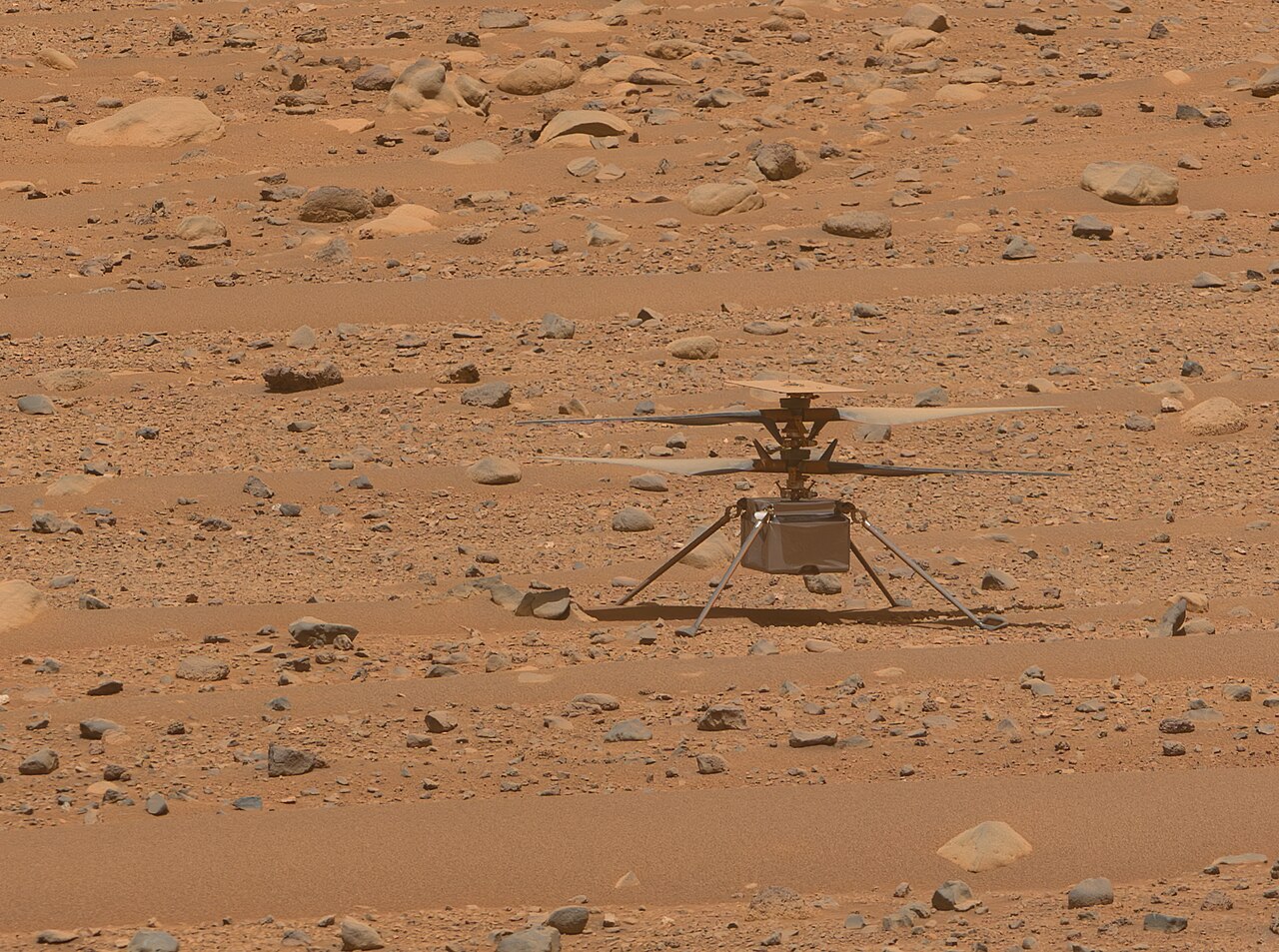
NASA’s Ingenuity helicopter proved that powered flight is possible on another planet. The SkyFall mission, scheduled to launch in 2028, will continue that legacy with three helicopters for Mars exploration. Both use blade designs created specifically for the Martian atmosphere, with curved edges reminiscent of blades on Earth but with different characteristics.
Thinner and asymmetrical blades
A team at NASA’s Ames Research Center in Silicon Valley, California, worked with Imperial College London in the United Kingdom and Nagoya University in Japan. They tested a new blade cross-section, or airfoil, designed using advanced simulations and algorithms tailored to conditions on Mars.
The result was roamx-0201, a thinner, sharper, and asymmetrical airfoil. Wind tunnel testing showed that the design improves aerodynamic performance and can recover more effectively from hazardous flight conditions. However, the technology is not yet ready to be sent to Mars because differences between computer predictions and actual test results still need to be understood and resolved.
Potential for greater flight range
High-fidelity simulations compared the performance of roamx-0201 with Ingenuity’s capabilities. The results indicate that the new blade could potentially extend the distance of a single nonstop flight from 0.7 kilometers to as much as 18.7 kilometers while carrying scientific instruments. The findings were announced in a paper published on September 22 in the journal of the American Institute of Aeronautics and Astronautics.
One advantage is its ability to operate longer at high speeds before experiencing drag divergence. This phenomenon occurs when a rotor approaches the speed of sound and its performance suddenly declines. The challenge is particularly important on Mars because the speed of sound there is lower than on Earth.
Deliberately using turbulence
As air flows over a blade, it forms a thin layer known as the boundary layer. Roamx-0201 deliberately disrupts the flow within this layer near the blade’s leading edge. This disruption helps pull the blade upward, allowing it to generate lift more effectively than previous designs.
The new design also performs better when encountering stall, a condition in which a change in the airflow angle causes aerodynamic performance to decline sharply and flight to become unstable. Under the conditions studied, the performance of Ingenuity’s blades dropped sharply during stall, while roamx-0201 could operate across a wider range of flight angles.