An educational article with references listed below.
Four members of NASA’s simulated Mars crew have completed one year of living and working in isolation at Johnson Space Center in Houston. Since entering the habitat on October 19, 2025, they have followed a daily routine as though they were on the Red Planet. The experiment is helping scientists study human needs during long-duration space travel.
Living as They Would on Mars
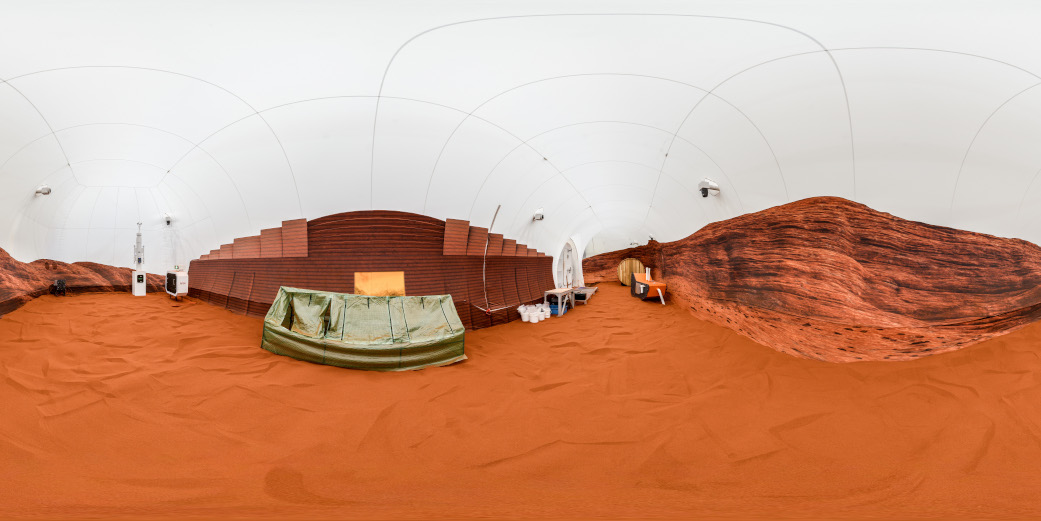
The program, called Crew Health and Performance Exploration Analog, or CHAPEA Mission 2, places the crew in a 1,700-square-foot, three-dimensionally printed habitat. For 365 days, they have had to work in a confined space while following operational conditions designed to resemble a Mars mission.
The crew consists of Ross Elder as mission commander, Ellen Ellis as medical officer, Matthew Montgomery as science officer, and James Spicer as flight engineer. They grow plants, manage limited resources, conduct activities outside the habitat in specialized suits, and work on a simulated Martian surface.
Delayed Communication
One of the major challenges of a mission far from Earth is the delay in communication. The crew cannot rely on real-time conversations as they would in everyday life. During the mission, they communicate with their families only through emails delayed to replicate communication conditions from Mars.
In the scenario studied by NASA, messages can be delayed by up to 45 minutes in each direction. This means that a question and its answer may take a considerable amount of time to complete. The situation requires the crew to make decisions more independently, including when dealing with medical, technical, or operational issues. The research data may help NASA develop decision-support systems suited to these conditions.
Measuring Body and Mind
An analog mission does not take humans to Mars, but it allows certain conditions to be tested in a controlled environment on Earth. Researchers collect physiological, psychological, and performance measurements to understand how demanding routines, limited space, isolation, and restricted resources affect people over the long term.
NASA also wants to determine how limited food supplies and exercise facilities affect the crew’s ability to accomplish mission objectives. Fitness and health are important because future explorers will still need to perform physical work, including activities outside their spacecraft on the Martian surface. The findings are expected to help determine the medical and psychological care needed when assistance from Earth cannot be provided immediately.
Final Stage After 378 Days
One year does not mark the end of the entire experiment. The mission is scheduled to last 378 days, and the crew is expected to leave the habitat on Saturday, October 31. They will then be able to reunite with their families after communicating for so long only through delayed emails.
After leaving the habitat, the crew will take part in evaluations and debriefing sessions with NASA scientists for two weeks. This stage is important for understanding how they adapted to the demands of daily life, maintained productivity, and preserved social relationships. Knowledge gained from this realistic simulation may be applied to preparations for human missions to the Moon, Mars, and more distant destinations.