An educational article with references listed below.
Before astronauts set foot on the lunar surface again, NASA will conduct one of the most complex test missions in the agency's history. Artemis III is scheduled to launch in 2027, carrying four astronauts into low Earth orbit rather than directly toward the Moon. There, the crew will test how the Orion spacecraft operates with two very different commercial lunar lander designs.
A Rehearsal Before the Landing
Artemis III is designed as a risk-reduction step ahead of an attempt to land astronauts near the Moon's South Pole in 2028. During the roughly 14-day mission, astronauts and flight controllers will practice spacecraft rendezvous, docking, use of crew compartments, and various operational procedures.
The mission crew consists of NASA astronauts Randy Bresnik, Frank Rubio, and Andre Douglas, along with ESA astronaut Luca Parmitano. They will remain aboard Orion, while test landers from Blue Origin and SpaceX are launched separately. The mission will therefore involve three spacecraft launched on three different heavy-lift rockets within a relatively short period.
Rendezvous With Blue Moon
The initial phase begins when Blue Origin launches the Blue Moon Mark 2 test vehicle into a circular orbit about 273 miles above Earth. The vehicle can remain in orbit for up to 30 days, allowing flexibility in the schedule for subsequent launches. Once it is confirmed to be in good condition, Orion will launch aboard an SLS rocket from Kennedy Space Center in Florida.
Orion will initially enter an elliptical orbit measuring 18 by 1,122 miles. The spacecraft will then perform a series of maneuvers to reach a circular orbit at about 345 miles to stabilize its thermal conditions before moving closer to Blue Moon. During the first two days, the crew will inspect Orion's systems and prepare for proximity operations and docking.
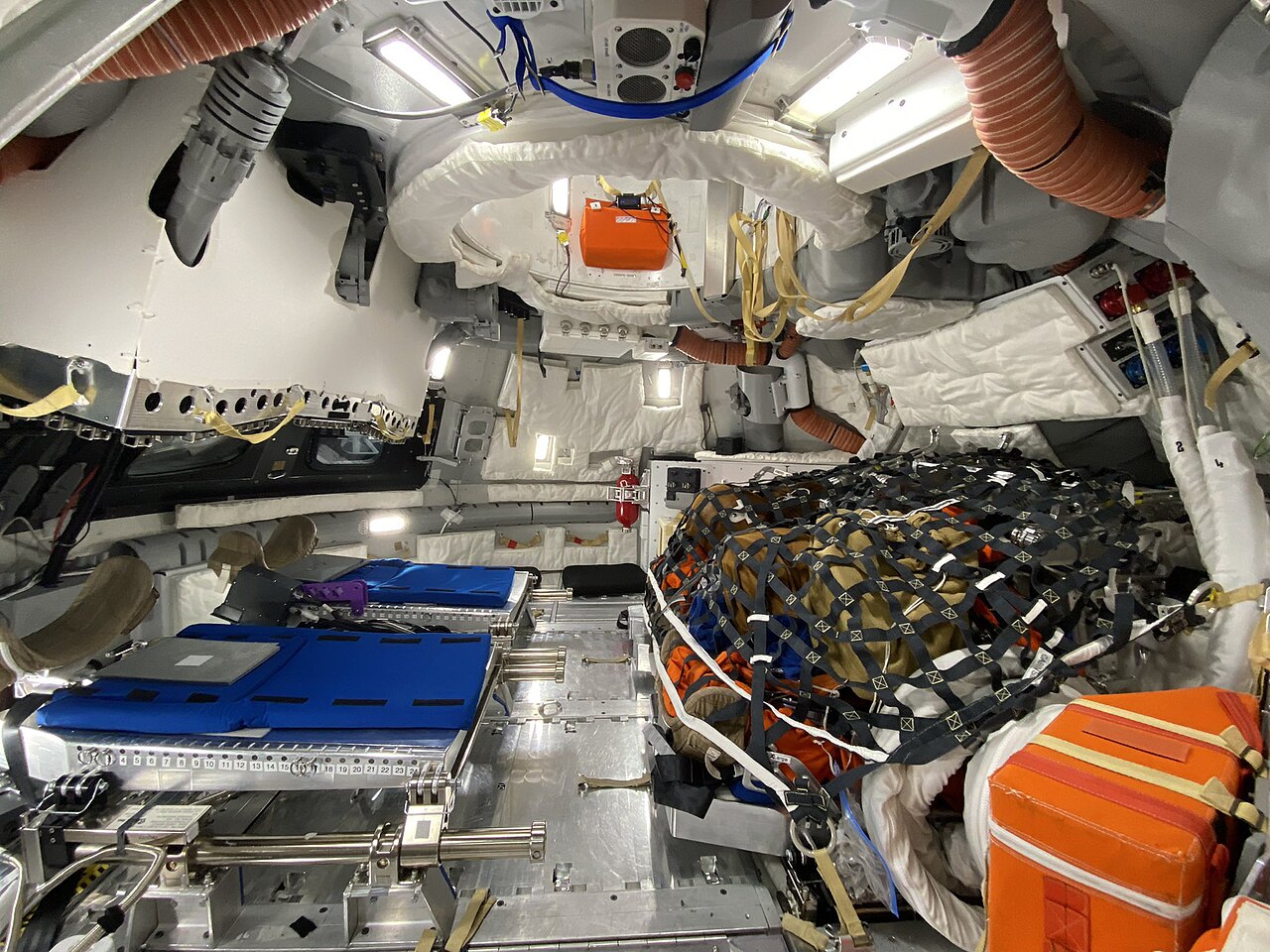
After the two vehicles are connected, the astronauts will enter Blue Moon for approximately two days. They will assess the cabin environment, controls, life-support systems, pressure, and the vehicle's ability to maintain a suitable atmosphere. This testing is important because systems that work independently on the ground may not behave the same way when integrated into a single vehicle in space.
Brief Test With Starship
After separating from Blue Moon, Orion will reposition itself to rendezvous with SpaceX's Starship Version 3 test vehicle. Starship will launch later because it is designed for a shorter period of operation in orbit. The vehicle will be in a 206-nautical-mile orbit and equipped with an additional docking system at the front.
Orion is scheduled to dock with Starship in a test lasting up to two hours. The astronauts will not enter Starship. The focus will be on assessing control capabilities, communications, integrated software performance, and the dynamics of the two spacecraft as they connect and separate again.
Two Designs, One Mission
Blue Moon and Starship use different docking positions. Orion will connect to a port on the side of Blue Moon's crew cabin, while with Starship, Orion's forward docking system will be aligned with the vehicle's nose. Using two approaches on a single flight will give NASA an opportunity to compare operational concepts while gathering engineering data.
Orbital coordination will be a major challenge because each vehicle operates at an altitude and in an orbital pattern tailored to its needs. Every maneuver must be carefully planned so that each rendezvous occurs at the right place and time. In addition to testing hardware, Artemis III will provide practice in coordination among the crew, flight controllers, NASA, and industry partners.