An educational article with references listed below.
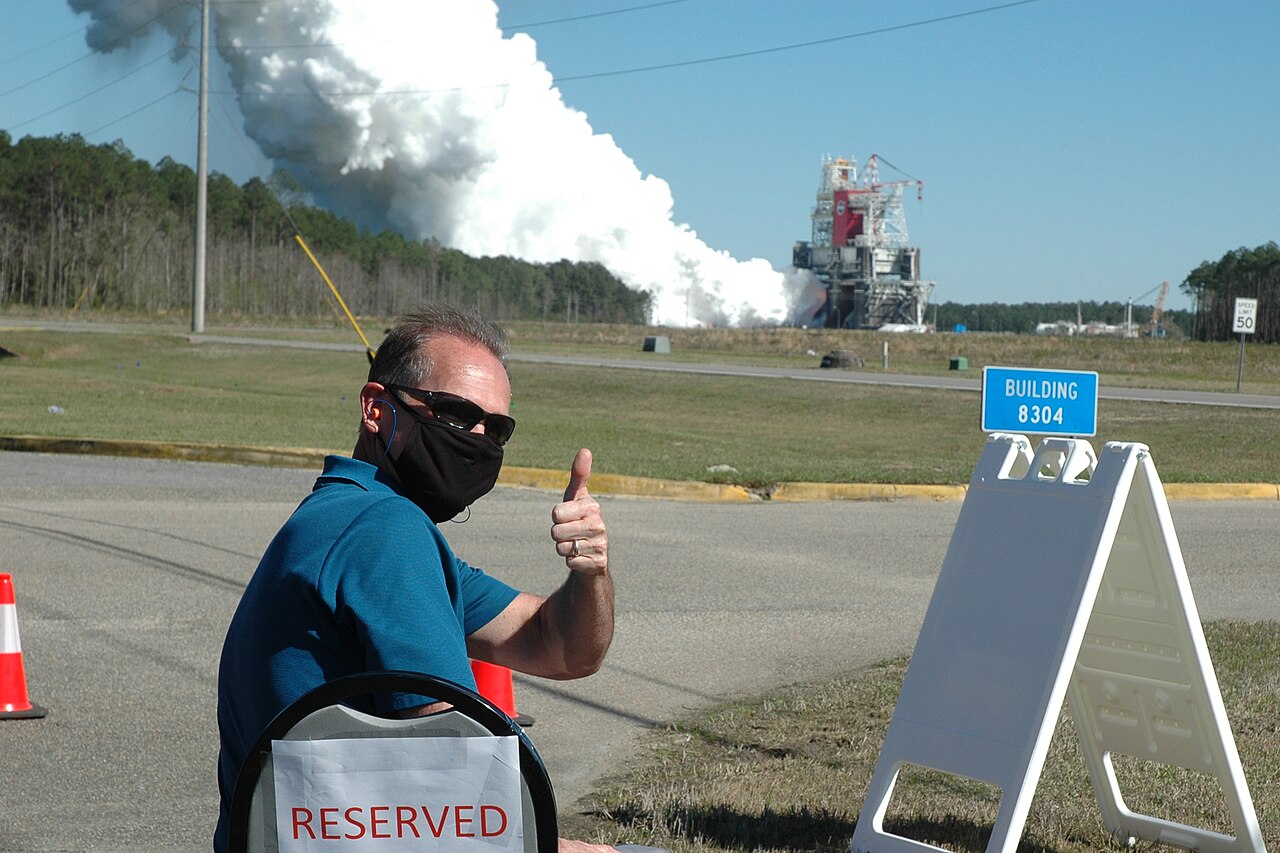
NASA tested RS-25 engine No. 10001 on October 21 at the Fred Haise Test Stand at Stennis Space Center near Bay St. Louis, Mississippi. The development engine was fired for 500 seconds to collect data needed in preparation for upcoming Artemis missions. The test also simulated how long the RS-25 operates as the SLS rocket travels toward orbit.
Simulating engine operation during launch
The test team fired the RS-25 for nearly eight and a half minutes. The 500-second duration matches the length of time the RS-25 engines operate while helping launch the SLS, or Space Launch System, rocket. By running the engine for an equivalent period, operators can observe its behavior under operating conditions similar to those required for launch.
In rocket engine testing, this process is known as a hot-fire test. The engine is actually operated, exposing its various parts to heat, pressure, vibration, and operational loads. Ground testing allows the team to obtain important measurements without having to wait for a launch.
Tested at 111 percent power
Operators also increased the engine to 111 percent power. This corresponds to the thrust required from newly produced engines to launch the SLS rocket and the Orion spacecraft toward orbit. The 111 percent designation is an operational power level used in the engine program; it does not mean that the engine exceeds the laws of physics or produces unlimited energy.
On each Artemis mission, four RS-25 engines work together and generate up to 2 million pounds of combined thrust. Thrust is the force that propels a rocket in the direction opposite to the engine's exhaust gases. The greater the mass of the rocket and its payload, the more force is needed to begin moving upward and overcome the pull of gravity.
Protecting the nozzle from heat
One of the test's main objectives was to validate a new thermal protection system. The system is designed to protect the RS-25 nozzle from the hot environment around the SLS during launch. The nozzle is the part of the engine that directs high-speed gases outward to generate thrust.
Thermal protection is important because the engine does not generate heat only through its internal combustion process. When multiple engines and rocket systems operate close together, the engine's exterior is also exposed to a severe thermal environment. The protective layer or design must perform its function without interfering with engine performance throughout the required operating period.
A test engine that supports flight engines
RS-25 engine No. 10001 is a development engine and will not be used for flight. Even so, its hot-fire test allows NASA and prime contractor L3Harris Technologies to collect critical data to improve engine performance and reliability. The test also serves as an acceptance test for RS-25 flight components being prepared for upcoming Artemis missions.
Before use, every RS-25 engine is tested at NASA Stennis and must be proven flightworthy. The testing is conducted by operators from NASA, L3Harris, and Nova Space Solutions. This approach shows that a successful launch depends not only on the moment the rocket leaves the launchpad, but also on the extensive checks carried out long beforehand.