An educational article with references listed below.
A barred spiral galaxy stands out in an image from the Hubble Space Telescope, but the most important object is in the lower-right corner. There, the gravity of a closer galaxy bends the light of a distant galaxy into a pair of arcs. The image is part of preparations for research using the Nancy Grace Roman Space Telescope.
Gravity as a cosmic lens
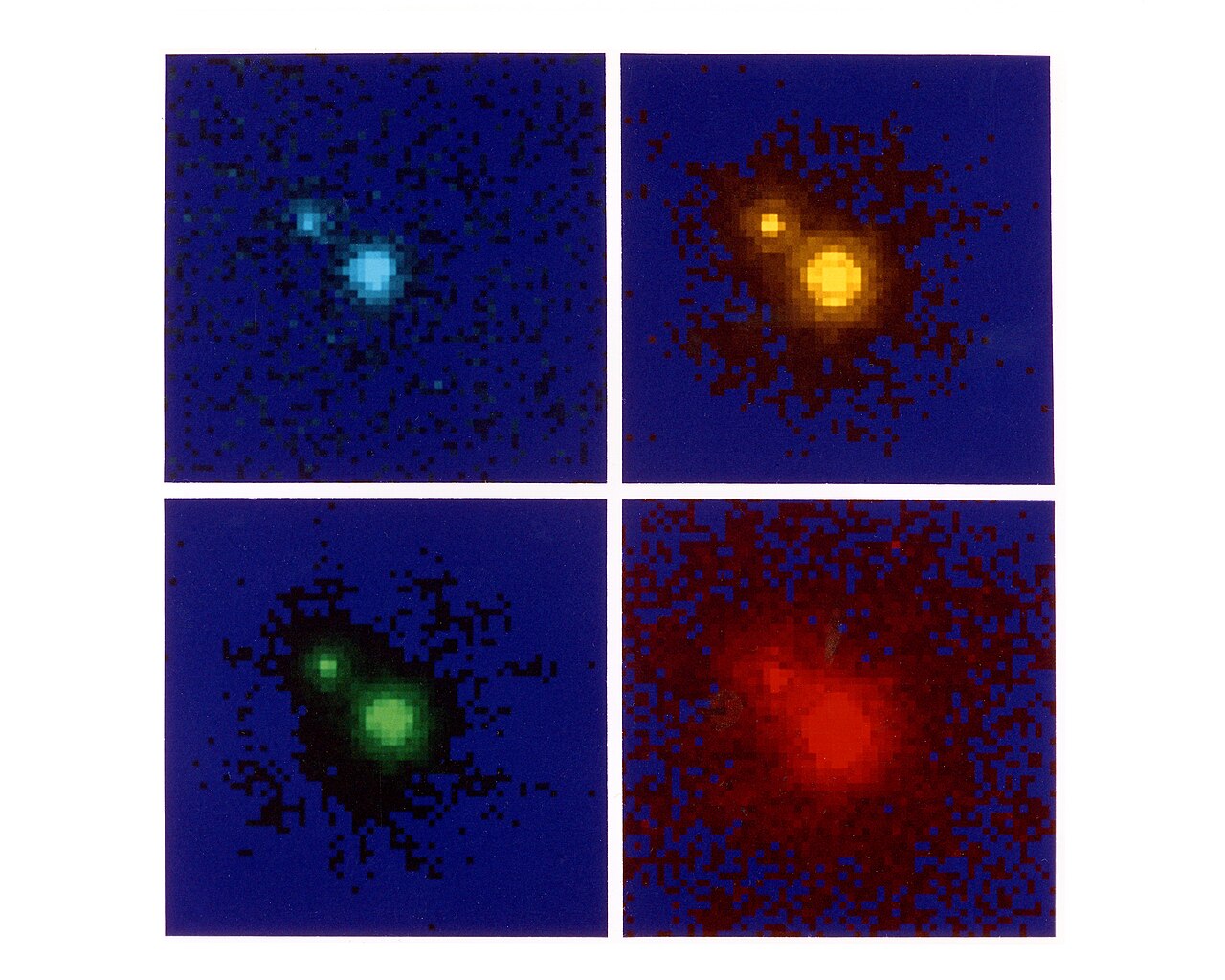
Gravitational lensing occurs when the mass of a foreground object, such as a galaxy, curves spacetime. Light from a galaxy behind it then follows a curved path as it passes through the region. As a result, the distant object may appear brighter, distorted, or visible in multiple images, as though it were being observed through a giant lens in space.
This phenomenon requires a highly precise alignment between the foreground galaxy, the background galaxy, and the observer. In the Hubble image, the foreground elliptical galaxy is about 4.5 billion light-years away. The light now visible from it began traveling toward us when the solar system was still forming. The background galaxy is about eight billion light-years from Earth.
One galaxy, two arcs of light
The background galaxy appears as two arcs around the elliptical galaxy. The larger and clearest arc lies to the upper left of the foreground galaxy, while a smaller, inverted image is visible at the lower right. This configuration is known as an arc-counterarc pair.
The shape does not mean that there are two identical background galaxies. Both are images of the same distant galaxy, but their light has traveled along different paths because of the curvature of spacetime. By measuring their shapes and degree of distortion, astronomers can investigate the mass producing the lensing effect.
Clues about dark matter
The greater the mass of the foreground galaxy, the stronger its lensing effect and the greater the bending of light. Visible matter, such as stars, is not enough to explain all the distortion of the background galaxy. The difference helps researchers calculate the total mass of the foreground galaxy while estimating its dark matter content.
Dark matter is an invisible substance that accounts for most of the mass in the universe. It is not observed through emitted light but is studied through its gravitational effects. Gravitational lensing therefore acts as a natural measuring tool for tracing mass that cannot be seen directly.
Hubble and Roman complement each other
Hubble primarily observes visible and ultraviolet light, with some infrared coverage. The telescope can produce high-resolution images of individual objects. Roman will operate mainly at infrared wavelengths and partly in visible light, with a much wider field of view for creating panoramas of the sky.
Hubble can observe gravitational lenses only one at a time, while Roman is expected to provide a larger sample in its wide-field images. Astronomers are using the sharpness of Hubble images to build computer models that can identify and analyze distortions caused by dark matter in Roman data. Hubble will also conduct follow-up observations of noteworthy lenses discovered by Roman.