An educational article with references listed below.
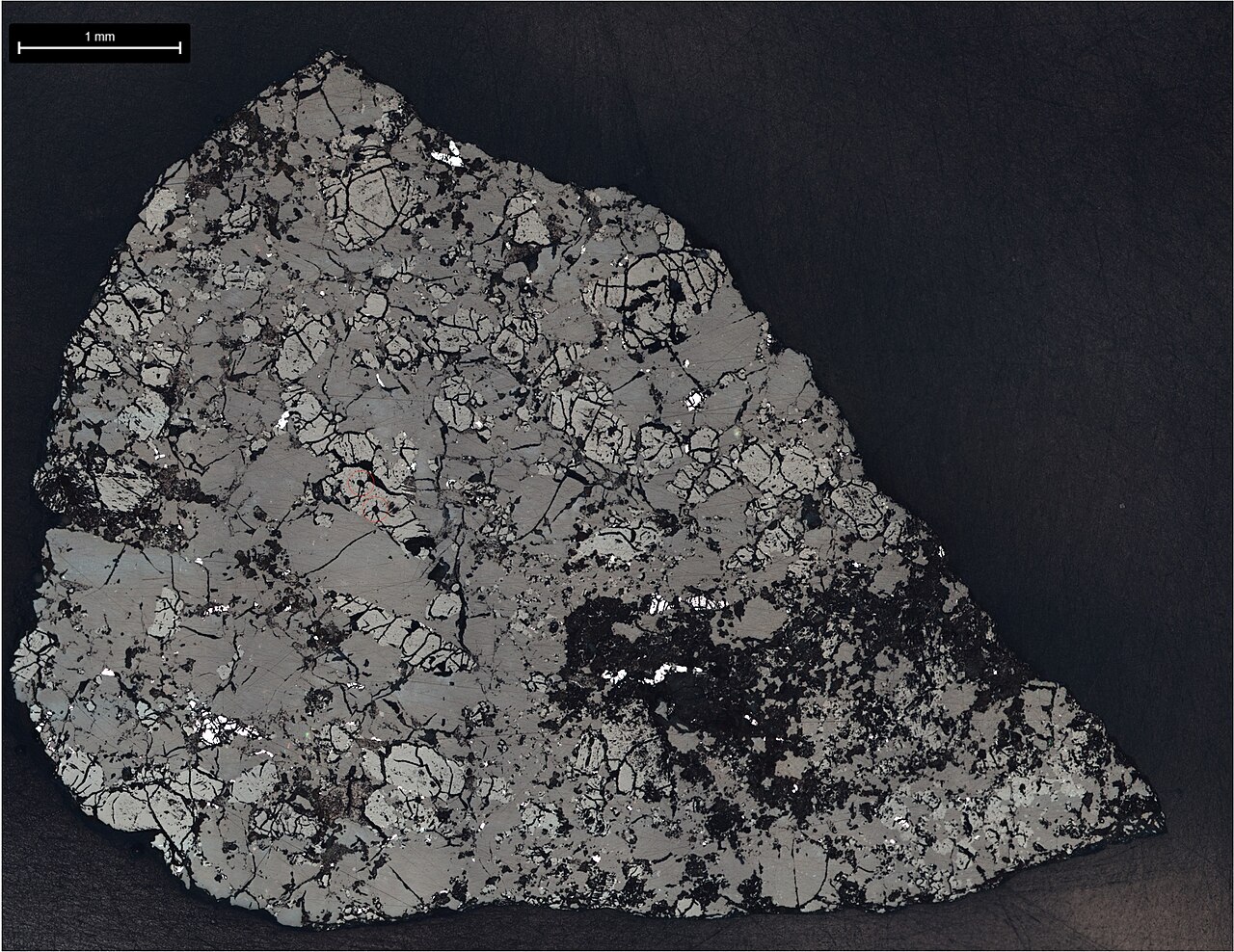
At first glance, the Teghaza 001 slice merely shows grains with varying levels of brightness. However, a reflected-light image of one of the most ancient Martian meteorites ever found on Earth serves as a map for scientists. The slice is used to determine the rock’s age and locate minerals suitable for examination with various instruments.
A Mineral Map Within the Rock
A reflected-light image is created by observing light reflected from the surface of a rock slice. Differences in minerals, textures, and surface properties make some grains appear brighter or darker. This pattern helps researchers select small areas for further analysis, preventing the examination from being conducted at random.
In the annotated image of Teghaza 001, the brightest grains were identified as iron-titanium oxides. Pyroxene appears medium gray, while shock-altered plagioclase looks darker. These identifications provide initial clues about the rock’s history before measurements are conducted with other instruments.
Traces of Mars’ Formation
Iron-titanium oxides and pyroxene can reveal information about the formation of Mars’ crust and mantle. The crust is a planet’s outermost rocky layer, while the mantle lies beneath it. Minerals form under specific physical and chemical conditions, so their presence and arrangement can preserve a record of the processes the rock has undergone.
Teghaza 001 is highly valuable because it is among the most ancient Martian meteorites found on Earth. Determining the age of this slice helps place the rock within the sequence of Mars’ geological history. Although the numerical result is not stated, the process allows scientists to connect the mineral composition with the period when the rock formed.
Extreme Pressure From an Impact
Shock-altered plagioclase is evidence that the rock was once subjected to immense pressure. Such changes can occur when an impact generates pressure waves that travel through the rock, altering the structure or texture of its minerals without necessarily erasing all of the original material.
One such extreme impact ejected Teghaza 001 from Mars. The rock fragment then traveled through space before eventually reaching Earth. The dark areas in the image are therefore not merely color differences, but physical traces of the event that made it possible for Martian rock to end up in scientists’ hands.
Changes After Reaching Earth
Not every mineral in this slice records conditions on Mars. Areas described as alteration contain fine-grained carbonates, sulfates, and clay minerals that formed on Earth. Distinguishing their origins is important so that changes occurring after the meteorite’s arrival are not mistakenly interpreted as evidence of the Martian environment.
Researchers must read the rock as a collection of historical layers: its initial formation as reflected in its minerals, the pressure caused by an impact, its journey to Earth, and the changes that occurred after it entered the terrestrial environment. The reflected-light image provides an initial map for distinguishing these components and identifying targets for further analysis.