An educational article with references listed below.
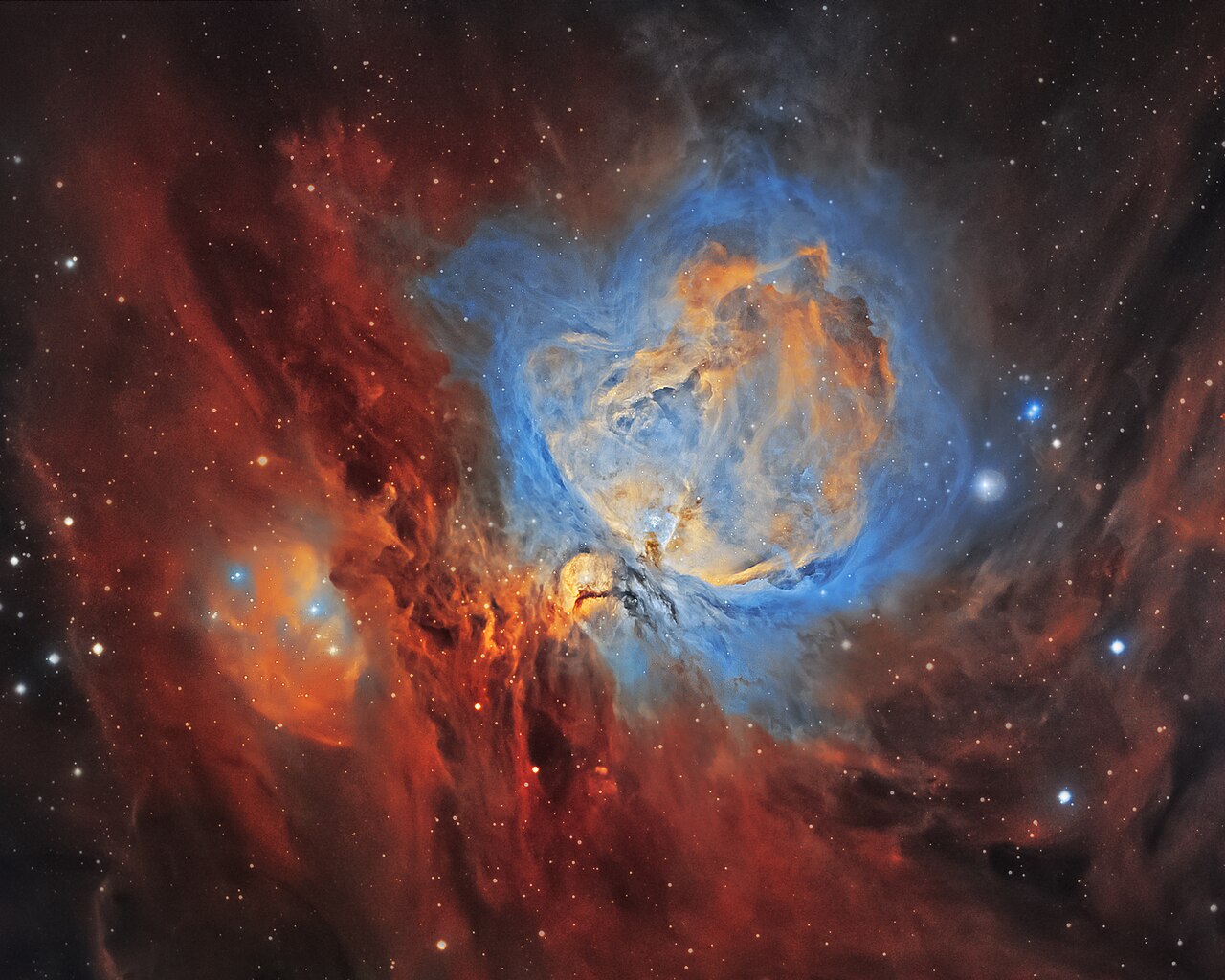
The Orion Nebula, or M42, was the astronomical image featured by NASA on October 26, 2026. The deep, color-mapped image reveals glowing gas, sheets of dust, and young stars in a vast stellar nursery. In astronomical terms, it is relatively nearby, about 1,500 light-years from Earth.
An active cosmic cloud
The nebula is not merely a clump of mist drifting without activity. M42 lies at the edge of an enormous interstellar molecular cloud. In this environment, gas and dust provide the material for star formation, while hot young stars cause the surrounding gas to emit light.
The image uses mapped colors to highlight hydrogen emissions. This technique makes structures that are difficult to distinguish more visible, including thin filaments and layers of gas and dust. Colors in images like this serve as tools for interpreting the region’s composition and shape, rather than simply depicting what the human eye would see directly.
Where young stars grow
M42 contains many sites of star formation. Its environment includes large quantities of hydrogen gas, hot young stars, proplyds, and high-speed outflows of material known as stellar jets. Proplyds are structures of material around young stars associated with the early stages of stellar system development.
Stellar jets show that star birth is not a quiet event. Material can be ejected from the vicinity of young stars and travel rapidly through the surrounding gas. These interactions help create the intricate patterns seen as arcs, filaments, and layers in images of the nebula.
The Trapezium at the heart of the nebula
The Orion Nebula is also home to a bright open cluster called the Trapezium. An open cluster is a group of stars that formed in the same environment and still appear close together. The bright young stars in this region help illuminate the surrounding gas, making M42 easier to recognize than many other nebulae.
Overall, M42 spans about 40 light-years. A light-year is the distance light travels in one year, so this measurement shows that the star-forming region is extremely large. The Orion Nebula lies in the same spiral arm of the Milky Way Galaxy as the Sun.
Visible without a telescope
Although it is about 1,500 light-years away, the Orion Nebula can be seen with the naked eye. It is located near Orion’s Belt, an easily recognizable row of three stars in the constellation Orion. From Earth, M42 appears as a small, faint patch, while deep astronomical images reveal far more detail in its gas and dust.
M42’s relative proximity and the abundance of young stars within it make the nebula a clear example for understanding star birth. The light arriving now carries an image of the region from about 1,500 years ago because light takes time to cross interstellar distances.