An educational article with references listed below.
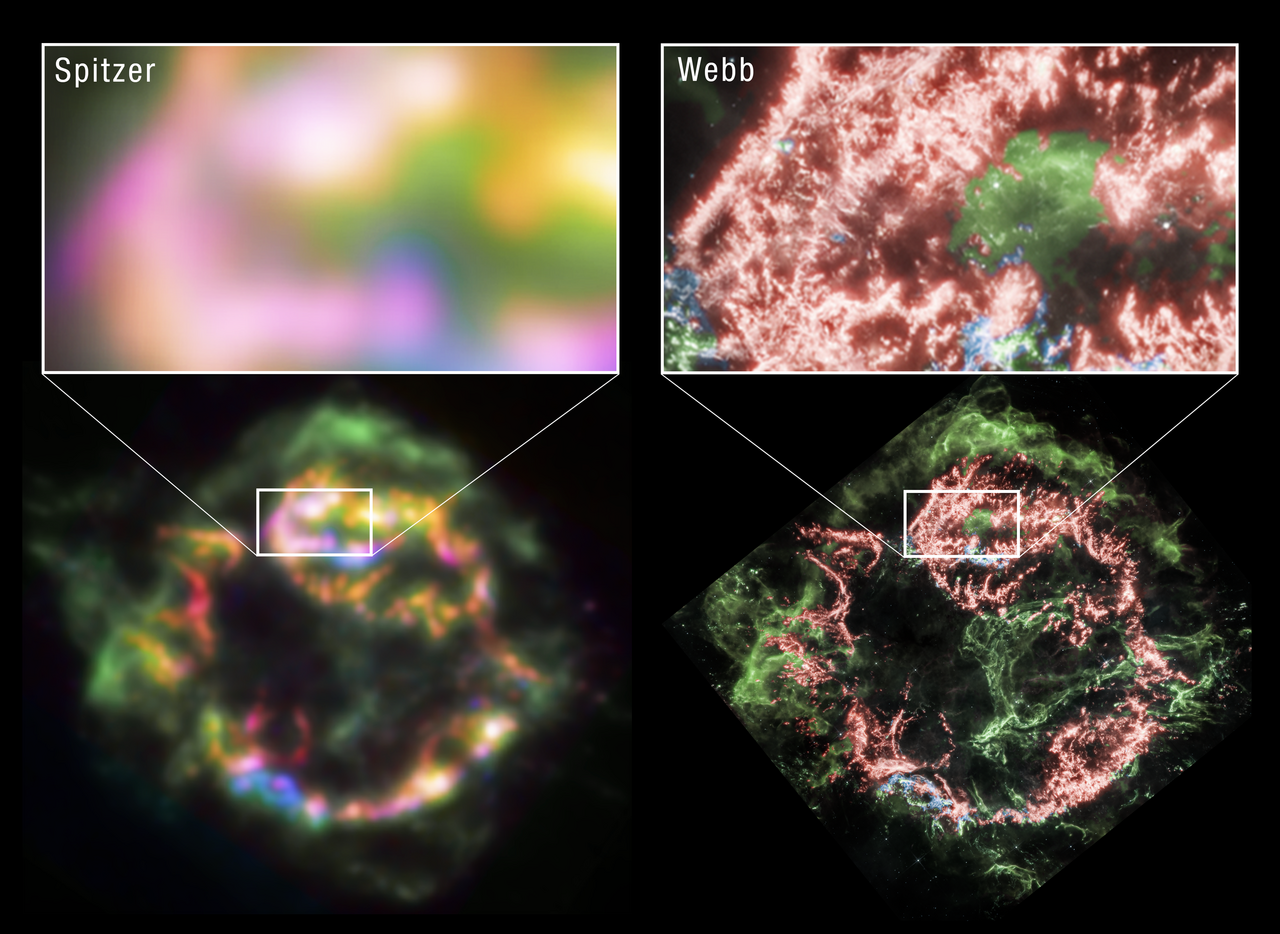
NASA’s James Webb Space Telescope revealed details of hot dust in Cassiopeia A, or Cas A, through a high-resolution mid-infrared image released on November 23, 2026. This cloud of gas and dust is the remnant of a massive star’s explosion. In addition to showing the material left behind, Webb’s observations offer clues to possible major changes inside the star as it approached its destruction.
What remains after a star explodes
A supernova is a stellar explosion that ejects material into space. For massive stars, the end of life can produce a cloud of gas and dust that persists after the explosion. Such a cloud is called a supernova remnant, and Cas A is the subject of Webb’s observations in this release.
The image of Cas A is therefore not a portrait of a star that is still intact. What it shows is the material left behind by its destruction. Studying that material helps scientists investigate events that have already occurred, much like examining traces to understand an earlier sequence of events.
Why observe in infrared?
Webb’s image reveals hot dust through mid-infrared observations. Infrared is light that the human eye cannot see directly. Warm objects emit radiation, and observations at infrared wavelengths can help reveal the presence and properties of material that is difficult to study using visible light alone.
Astronomical dust is more than an obstacle to our view. These tiny grains also carry information about their surroundings. By recording their emissions, telescopes can provide another way to study the remnants of an explosion. High resolution helps reveal structural details that form part of that investigation.
Clues to changes before the explosion
According to NASA’s release, Webb’s data support a scenario in which the star’s interior underwent dramatic changes, perhaps just hours before the end of its life. This connects observations of the explosion’s remnants with questions about the star’s condition while it still existed, just before its destruction.
However, “support” does not mean confirming the entire sequence of events. The timescale of a few hours is also presented as a possibility, not a certainty. Webb is not directly recording the star’s interior before it exploded; scientists are using observations of its remnants to test explanations of its past.
A star’s end, the beginning of new material
Clouds such as Cas A also play a role in the journey of matter through the universe. NASA explains that the gas and dust left by the explosion will eventually become part of the supply of material for future generations of stars and planets. The destruction of a star is thus connected to the formation of new objects.
That process does not mean Cas A immediately turns into a planetary system. The material must undergo further movement and formation processes. The broader picture is a cycle: material released at the end of a star’s life can once again take part in forming other structures in space.