An educational article with references listed below.
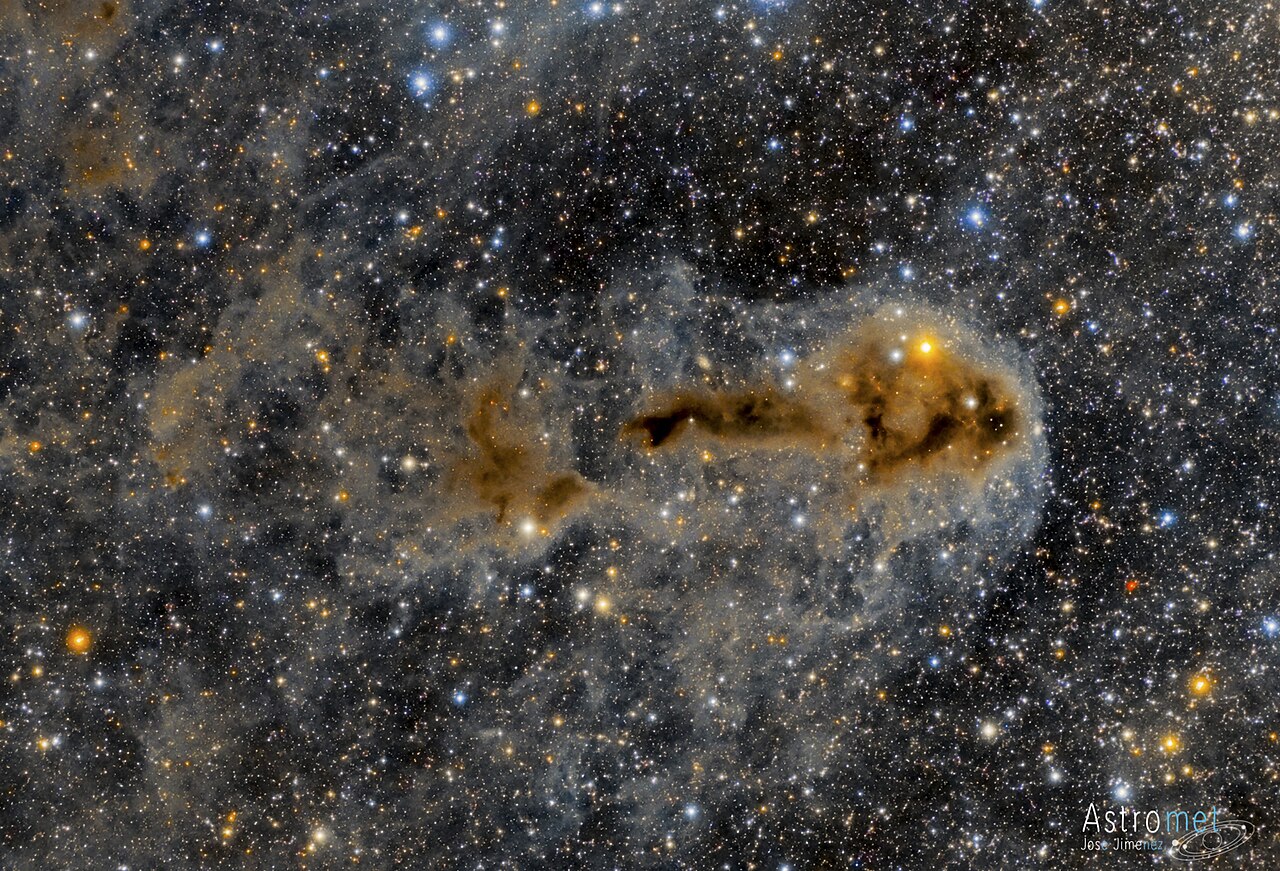
A patch of sky that appears to contain few stars is not necessarily empty space. In Lynds 1251, interstellar dust that blocks light is an important part of a star-forming region. Through its Astronomy Picture of the Day on November 23, 2026, NASA shows how long observations can reveal this dark structure more clearly while also showing the active environment within it.
When darkness becomes visible
NASA’s explanation invites readers to imagine observing the sky for longer and longer periods. At first, only the bright stars are easy to see. After a few minutes of collecting light, some areas that appear to have no stars become recognizable. The longer the observation continues, the clearer the shapes of these dark regions become.
In this account, 20 hours of light collection reveal a distinctive dark structure. With a camera, long observations allow faint light to accumulate, making details that were initially difficult to distinguish more visible. This does not mean the object suddenly appears; rather, the recorded observation becomes richer in information.
Dust that blocks the light
The object is called Lynds 1251, or LDN 1251, and is also nicknamed the Rotten Fish Nebula. NASA describes it as a star-forming region filled with opaque interstellar dust that appears brownish. The term dark nebula refers to its ability to block light, not to an absence of material within it.
Dust grains can absorb or scatter light passing through them. As a result, light from stars behind the cloud has more difficulty reaching the observer, making that part of the sky appear darker than its surroundings. This contrast helps reveal the cloud’s shape: something that blocks light can be recognized through the light that does not reach us.
A dark but active place
Although its appearance is dominated by dark dust, LDN 1251 is not a quiet environment. According to NASA’s explanation, the region hosts young stars and displays high-energy shock waves, fast stellar winds, and powerful, directed jets. This picture shows that star formation takes place in a dynamic environment.
Stellar winds are streams of particles moving away from stars, while directed jets carry matter in more focused flows. Shock waves can form when fast-moving flows interact with surrounding material. This basic explanation helps us understand why a cloud that looks motionless in a photograph can harbor movement and energy transfer.
The role of image processing
Collecting light is not the only step NASA describes. After the long observation, digital processing is used to brighten the image and enhance its colors. The aim is to help reveal structures and color differences that are difficult to recognize in the initial view.
An image like this is therefore not the same as the view seen directly by the eye when looking at the sky. The camera collects light, and image processing then helps present the details. Understanding this process allows us to appreciate the image’s beauty while also understanding how astronomical information is displayed.