An educational article with references listed below.
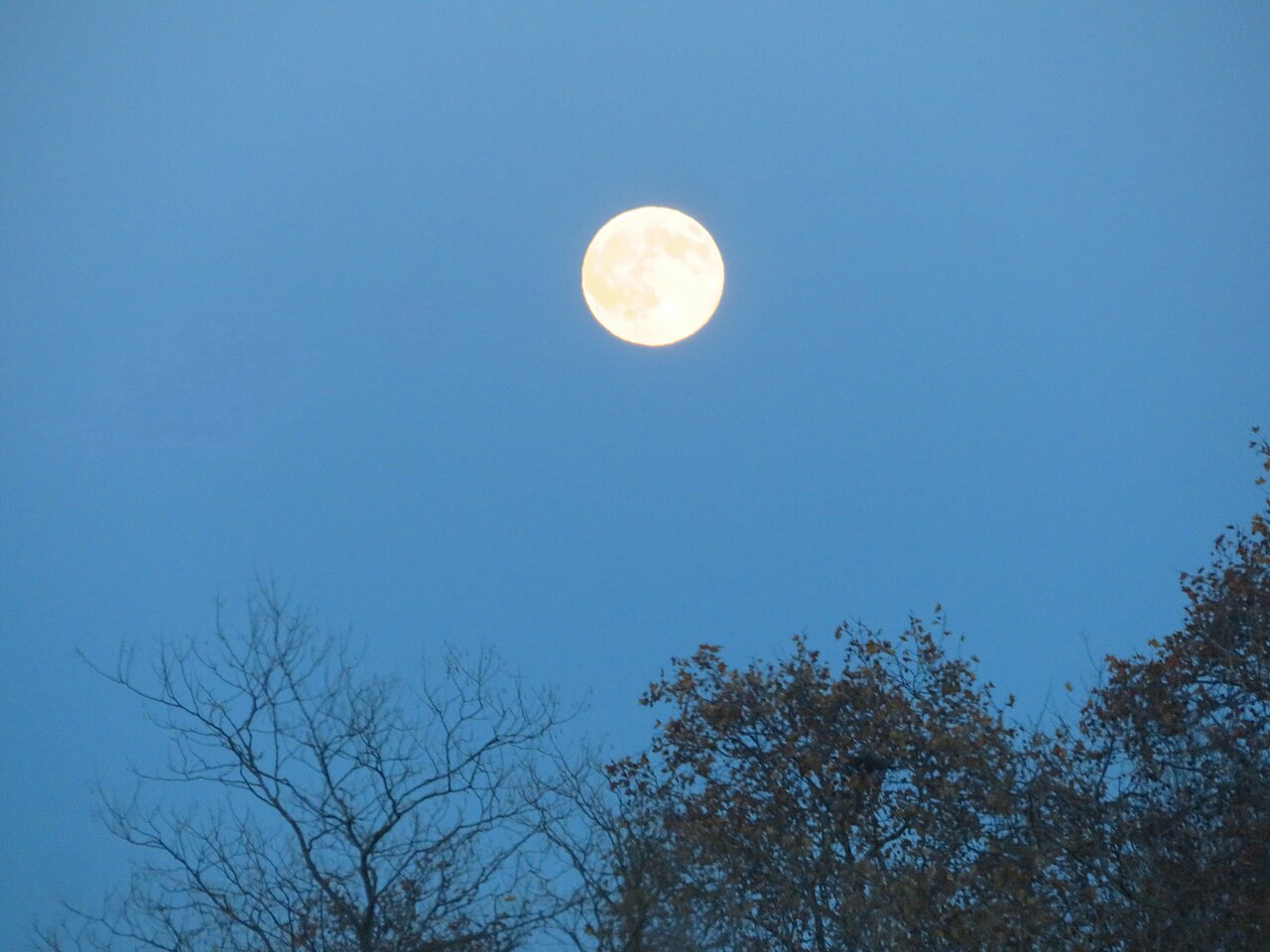
On November 24, the full moon rose opposite the setting Sun. In the twilight sky, the Moon appeared large and bright, offering a view that could be enjoyed from fields, home gardens, and behind stone walls. In its Astronomy Picture of the Day feature dated November 27, 2026, NASA highlighted this full moon as the first in a series of four consecutive supermoons.
A Full Moon at Twilight
A full moon occurs when the side of the Moon facing Earth is almost entirely illuminated by the Sun. In this alignment, the Moon lies opposite the Sun as seen from Earth. This is why a full moon can be seen rising as the Sun sets: one celestial body leaves the view while the other begins to appear.
The Moon does not produce its own light. The brightness we see is sunlight reflected from its surface. During a full moon, that illuminated portion is visible in its most complete form from Earth. Although the event can be observed widely, the opportunity to see it from any particular location still depends on sky conditions and an unobstructed view in the direction of moonrise.
An Orbit That Is Not Circular
The Moon’s distance from Earth is not constant because its orbit is elliptical rather than perfectly circular. Along that path, there is a point where the Moon is closest to Earth. This point is called perigee. The November full moon occurred when the Moon was near that part of its orbit.
Changes in distance affect an object’s apparent size: a closer object looks larger than it does when farther away. For this reason, a full moon near perigee can appear larger and brighter. The Moon itself does not grow; what changes is its distance from observers on Earth.
Why Is It Called a Supermoon?
A full moon that occurs near perigee is known as a supermoon. NASA described this November full moon as one of the largest and brightest full moons. The term describes the combination of two conditions: the full moon phase and the Moon’s position close to Earth in its orbit.
Some people know the November full moon as the Beaver Moon. That name does not explain what causes the Moon’s brightness. To understand its appearance, the factors to consider remain its phase and distance. By distinguishing the full moon’s name from its orbital conditions, we can appreciate the name without confusing it with astronomical mechanisms.
The Next Opportunity Comes in December
The November full moon was the first in a series of four consecutive full moons occurring near perigee. According to NASA’s explanation, the next opportunity to watch a supermoon rise is on December 23, when the full moon known as the Cold Moon appears.
To enjoy the next event, choose a location with an unobstructed view in the direction of moonrise and pay attention to local weather conditions. This simple observation also invites us to recognize the relationship between the Moon’s motion, its changing phases, and the sky’s transition from day to night.