An educational article with references listed below.
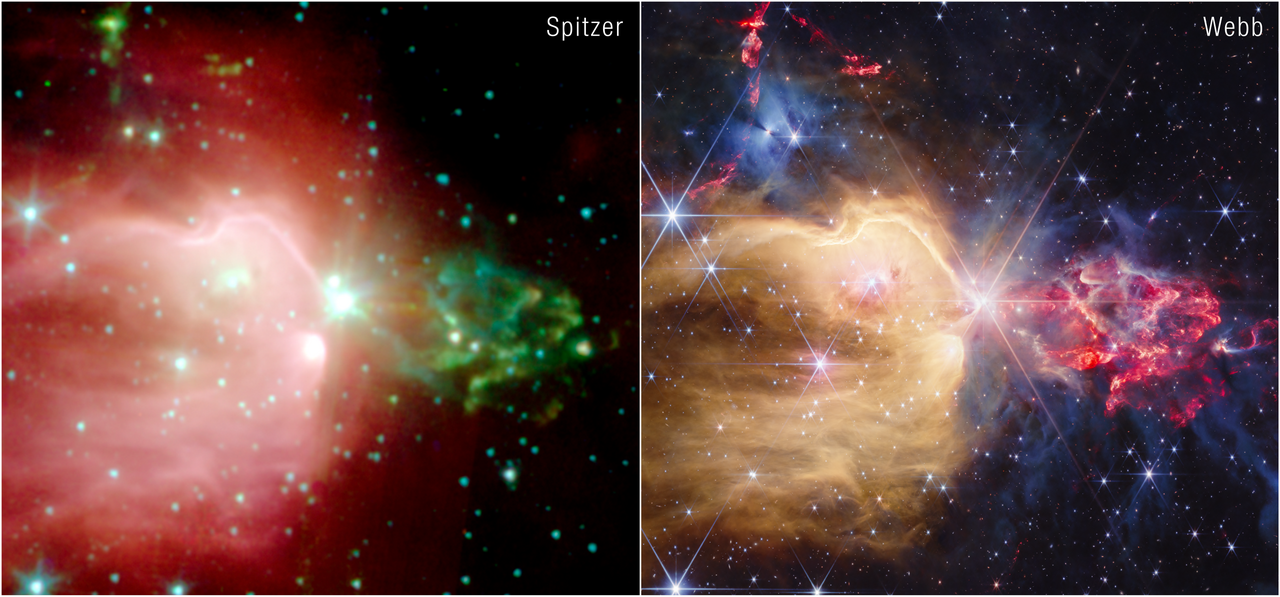
Stars are not born in quiet surroundings. In an image of the star-forming region NGC 7129 presented by NASA on November 16, 2026, gas and dust provide the setting for young stars at different stages of development. Observations with the James Webb Space Telescope in infrared light help reveal processes that are difficult to understand through visible light alone.
Gravity gathers gas
Star formation begins when gravity draws together large amounts of gas. This pull causes matter to become increasingly concentrated. In simple terms, gravity acts as a collector of matter, allowing a star to form from the interstellar environment.
However, the process involves more than a cloud of gas continuously contracting without disturbance. Stars that have already formed can change the conditions around them. To understand the birth of stars, astronomers therefore also need to consider how neighboring stars affect the gas and dust.
Jets that shape the surroundings
Stars that have formed can release powerful outflows, or jets, as well as stellar winds. Both carry matter and energy outward into the surrounding environment. Some stars may also eventually explode, so the life cycles of stars influence the places where the next generation forms.
In the image of NGC 7129, the red gas appears to have threadlike structures. According to NASA's explanation, this filamentary appearance is likely caused by jets and stellar winds. The word likely matters: the visible patterns offer clues about physical processes, but do not by themselves establish the full history of how those structures formed.
Seeing through the dust
Dust is one reason stellar birthplaces are difficult to observe. Dust particles can form in the atmospheres of cool stars and then spread into the surrounding environment. When dust lies along the line of sight, it can block visible light and hide parts of the scene.
Webb observes this region in infrared light, which has longer wavelengths than visible light. Infrared observations help astronomers investigate dusty regions because some of this radiation can pass through dust more easily than visible light. This means observations do not depend solely on the parts of the region that appear bright to the eye.
Comparing stages of growth
The image shows many stars in the process of forming. The young stars on the left, among the golden-colored gas, are generally more mature than the young stars on the right, in the red region. This difference offers an opportunity to compare several stages of development within a single region.
The colors in the image serve as guides to the areas being discussed, not as a simple rule that every star in the golden region must be older than every star in the red region. The central purpose of the observation is to compare the conditions of stars and their surroundings. Comparisons like this help astronomers understand which physical processes play the largest roles and when those processes become important.