An educational article with references listed below.
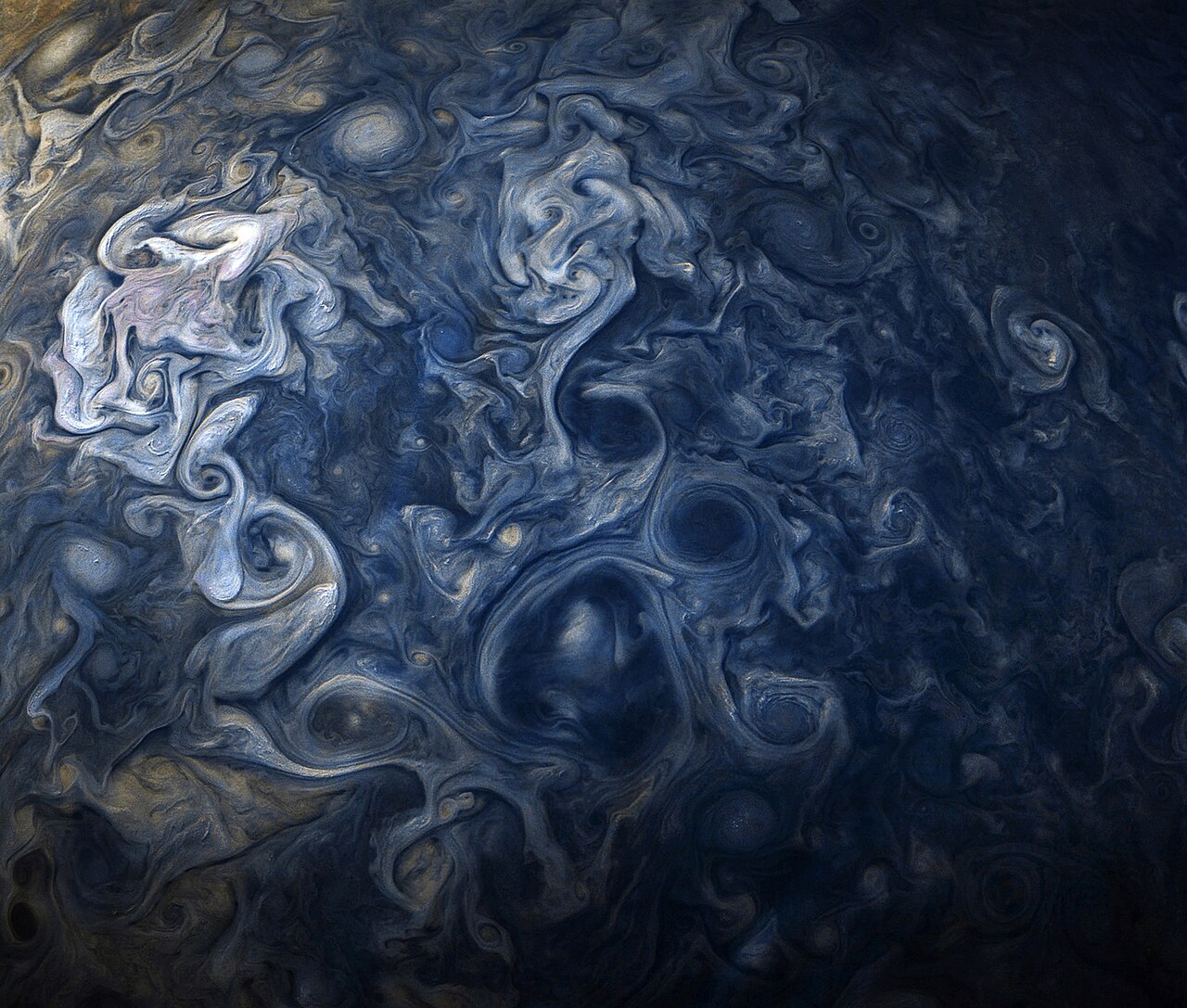
Bright swirls, reddish regions, and dark areas form a view of Jupiter’s atmosphere in an image from the Juno spacecraft presented by NASA on November 22, 2026. The image was captured in 2018, when Juno made its 14th close pass of the planet. Behind these striking patterns lies a scientific question that has yet to be answered definitively: what gives Jupiter’s clouds their colors?
The main gases do not determine the colors
Jupiter’s thick atmosphere consists mostly of hydrogen and helium. At the low temperatures found at the planet’s cloud tops, both elements are colorless. Their presence alone therefore does not explain why Jupiter’s clouds display different colors.
Researchers are still investigating trace molecules that might produce these colors. Trace molecules are components present in small amounts compared with the atmosphere’s main constituents. One leading candidate is ammonium hydrosulfide in small quantities. However, a candidate is not a confirmed answer; the identity of the substance responsible for the colors remains a subject of research.
Bright clouds offer clues to altitude
One thing is clearer than the origin of the colors: brighter clouds generally lie higher than darker clouds. This relationship is visible in the image selected by NASA as well as in many similar images. Differences between light and dark can therefore help readers recognize the arrangement of cloud layers, rather than simply appreciate their patterns.
In the lower right of the image, bright clouds appear to swirl around a reddish region. Meanwhile, in the upper right, bright clouds appear to cover part of a darker region. Arrangements like these convey a sense of depth: an atmosphere that looks like a patterned surface actually has layers at different altitudes.
Interpreting a color-enhanced image
This image has undergone color enhancement. This means its colors have been made more distinct so that differences in patterns and structures are easier to observe. Readers should distinguish this processed appearance from the assumption that human eyes would necessarily see colors with exactly the same intensity near Jupiter.
Color enhancement does not, by itself, reveal the chemicals that make up the clouds. An image can show where patterns occur, how regions relate to one another, and where bright areas appear to cover dark ones. Identifying the molecules responsible for the colors, however, is a separate question. This is why even a highly detailed image can still contain scientific uncertainty.
Juno’s passes offer different perspectives
Juno is a robotic spacecraft that captured the image during a close pass of Jupiter. In the description accompanying the image, NASA explains that the spacecraft follows an elliptical orbit that brings it close to the giant planet every 33 days, observing a slightly different sector on each orbit.
This orbital pattern allows different parts of Jupiter to be observed over time. The image of swirling clouds is one snapshot from those observations. Its value lies not only in the beauty of its shapes, but also in the clues it offers about atmospheric structure and the chemical questions that remain unanswered.