An educational article with references listed below.
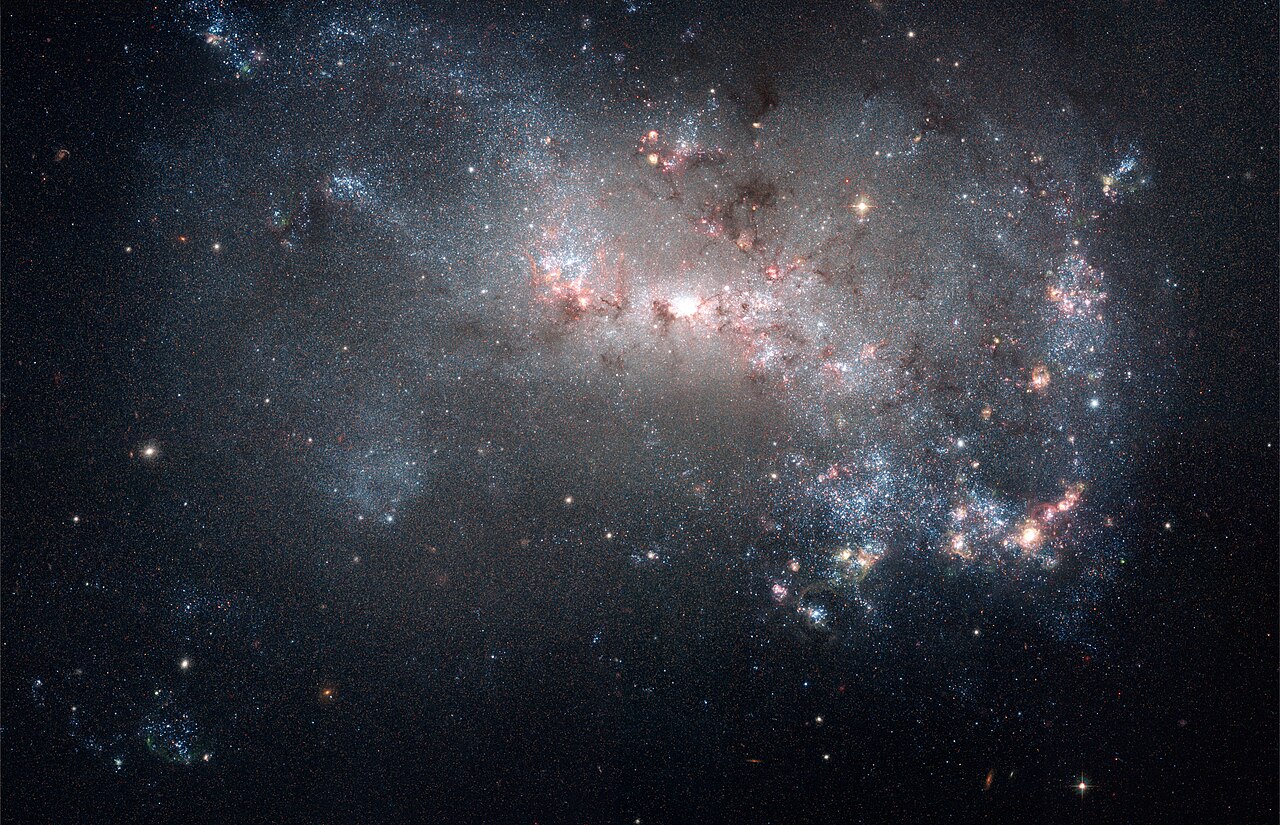
A galaxy’s size does not always reflect the importance of its role. In its Astronomy Picture of the Day feature on November 11, 2026, NASA presented an image of the dwarf galaxy NGC 4449 taken by the Hubble Space Telescope. This galaxy illustrates how relatively small systems can help disperse heavy elements beyond their boundaries.
Small on a cosmic scale
For comparison, our home galaxy, the Milky Way, spans about 100,000 light-years and contains hundreds of billions of stars. A light-year is a unit of distance: the distance light travels in one year. These figures illustrate the vast scale of a large galaxy.
According to NASA’s explanation, dwarf galaxies are about one-tenth the size of the Milky Way and contain only a few billion stars. The term dwarf is, of course, relative: from a human perspective, a collection of billions of stars is still an extraordinarily large system. Dwarf galaxies are also described as the most common type of galaxy in the universe.
Clues from missing oxygen
What makes NGC 4449 interesting is not just its size. This galaxy, along with similar dwarf galaxies, shows a greater oxygen shortfall than models predict. In other words, the amount of oxygen detected is smaller than expected based on calculations about the galaxy.
Scientific models help researchers estimate how a system works. When observations differ from predictions, the discrepancy offers a clue for testing existing understanding. In this case, the oxygen shortfall suggests that some of the element has been pushed out of the galaxy rather than simply remaining within it.
The driving force of stellar activity
NASA explains that stellar winds and supernovae appear to be highly effective at expelling oxygen and other heavy elements from these small galaxies. Stellar winds are streams of particles released by stars. Supernovae, meanwhile, are stellar explosions that can release energy and eject material into their surroundings.
In astronomy, the term heavy elements includes elements heavier than hydrogen and helium, including oxygen. Various processes inside stars produce elements that can later be released back into space. Stars are therefore not merely shining objects but also an important part of the cycle of processing and distributing matter.
A major role beyond the galaxy
If these elements escape, the influence of dwarf galaxies extends beyond the regions occupied by their stars. Ejected material can enrich the space outside galaxies with heavy elements. NASA says small galaxies such as NGC 4449 may play a major role in distributing the elements that make up stars, planets, and life throughout the universe.
However, this evidence needs to be understood within its limits. The oxygen shortfall supports the idea that material is being expelled effectively; it does not mean that the Hubble image directly shows the entire journey of every element. The main point is that small galaxies can be an important part of the exchange of matter on a cosmic scale.