An educational article with references listed below.
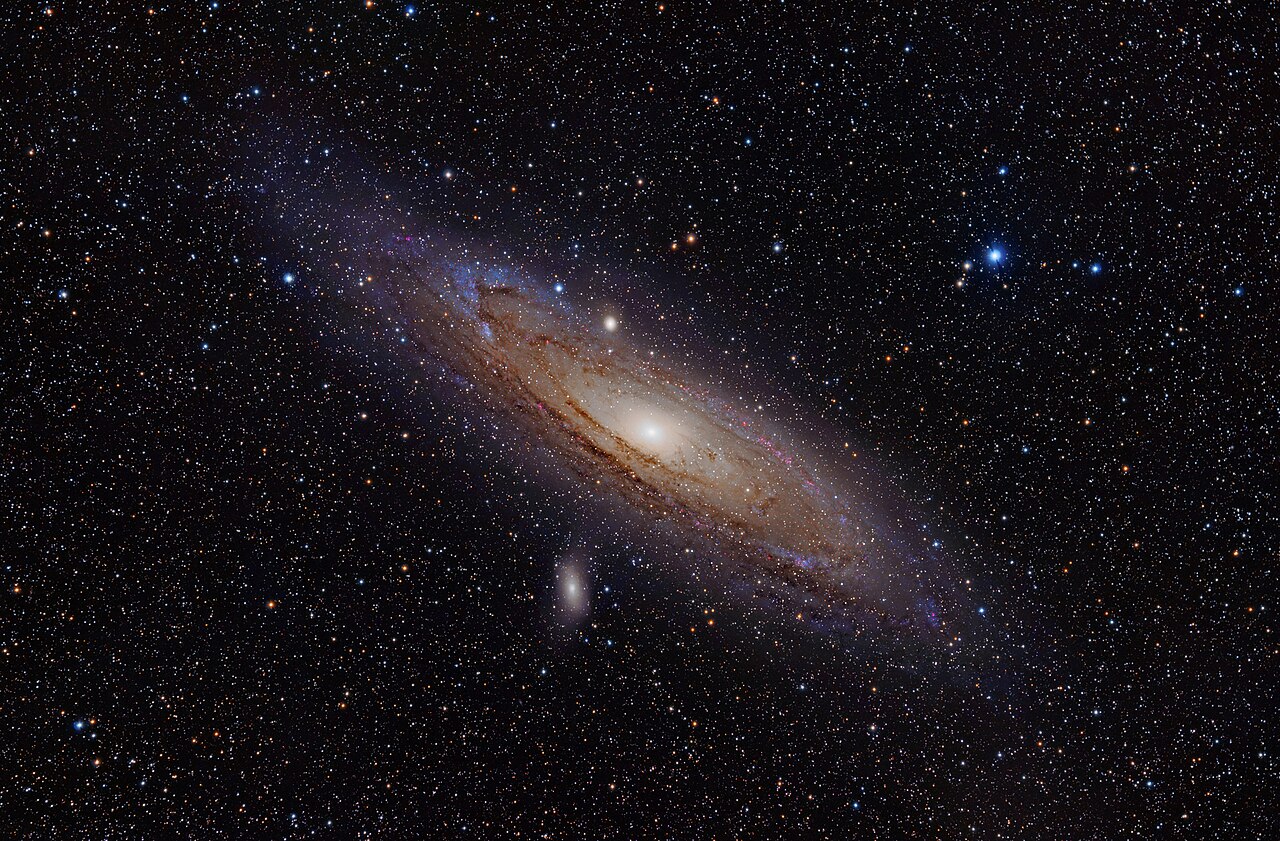
Among the dusty arms of the Andromeda galaxy, a large group of stars stands out with a bluish glow. Known as NGC 206, this region is the focus of the image featured in NASA’s Astronomy Picture of the Day on November 13, 2026. The image shows the southwestern part of Andromeda’s disk in sharp detail, while also inviting us to understand how a star’s color can offer clues to its age.
A stellar neighborhood in a nearby galaxy
Andromeda, also known as M31, is a spiral galaxy about 2.5 million light-years away. NGC 206 lies among its dust-bearing arms, alongside star-forming regions that appear pink. In this image, the group of stars is near the center of the field of view.
The term light-year describes distance, not age. One light-year is the distance light travels in one year. Because light takes time to reach us, observing distant galaxies is also a way of looking into their past. An image of Andromeda does not show its condition at the same moment we view it from Earth.
Why does blue indicate a young age?
Bright blue stars provide a clue that NGC 206 is a young stellar environment. According to NASA’s explanation, the youngest massive stars in the region are less than 10 million years old. That figure refers to its youngest massive stars; it does not mean that all the stars there are exactly the same age.
A star’s color is related to its surface temperature: blue stars are hotter than red stars. Hot, massive stars rapidly consume their fuel for nuclear reactions, so their lifetimes are relatively short. The presence of such stars indicates that they formed relatively recently on astronomical timescales.
An expanse far larger than an ordinary cluster
NGC 206 spans about 4,000 light-years. NASA describes it as much larger than the open clusters of young stars in the Milky Way’s disk. The term stellar association helps describe it as a large group of stars, rather than a single object emitting all that light.
To convey its scale, NASA compares NGC 206 with NGC 604 in the spiral galaxy M33 and the Tarantula Nebula in the Large Magellanic Cloud. Both are giant star-forming regions. The comparison concerns size, not a claim that all three share the same shape, number of stars, or every other characteristic.
Reading a galaxy’s life in a single image
This view brings together several important elements of a spiral galaxy: dust, pink star-forming regions, and groups of young stars glowing blue. Their presence in a single field of view helps readers see that a galactic disk is not simply a uniform expanse of light.
Yet even a beautiful image needs to be read alongside its accompanying explanation. The blue color offers a physical clue, while the figures for age and size provide context that cannot be established just by looking at the image. Together, the image and the astronomical explanation make NGC 206 easier to understand as part of the life of the Andromeda galaxy.