An educational article with references listed below.
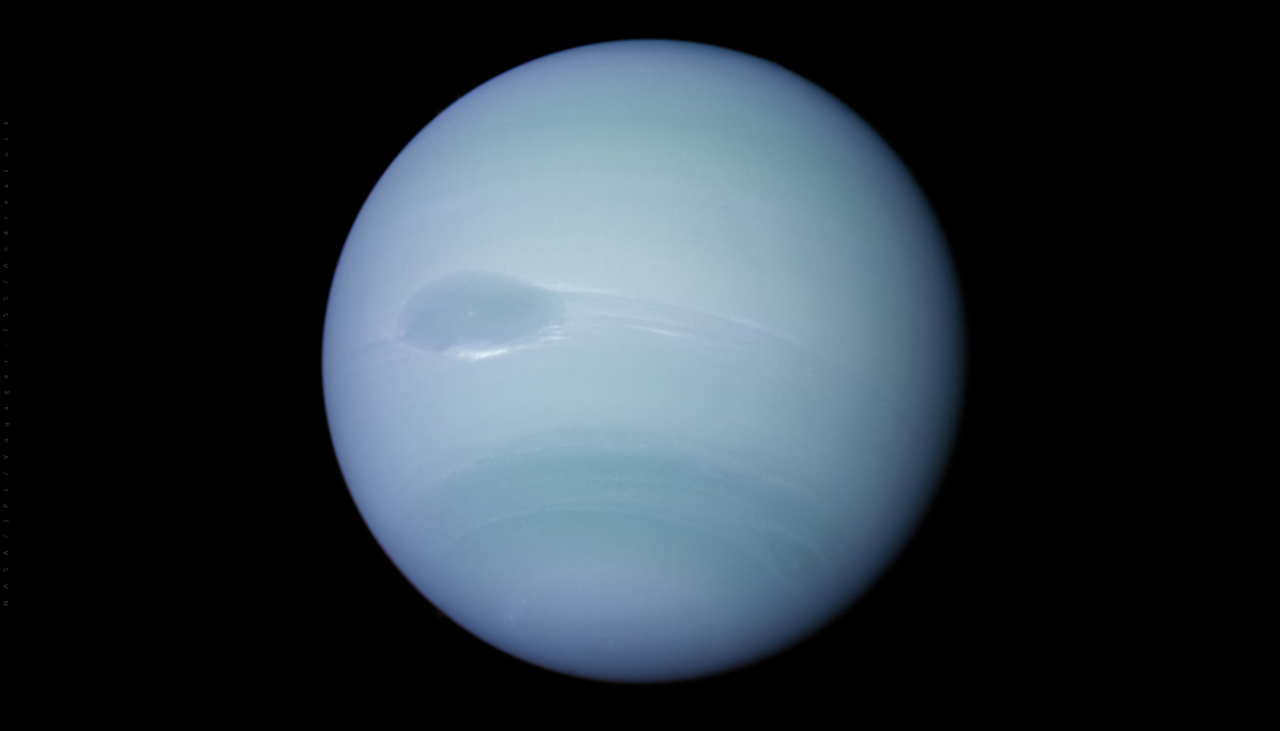
Neptune appears as a thin crescent, accompanied by its largest moon, Triton, and faint arcs of its rings. This view, featured in NASA’s Astronomy Picture of the Day, or APOD, on November 21, 2026, is a composite image based on imagery from Voyager 2’s encounter with Neptune. It is not a photograph from a new visit, but a fresh presentation of historic observations from a perspective that helps us envision the outer solar system.
Traces of the 1989 encounter
Voyager 2 made its closest approach to Neptune on August 25, 1989. It became the only spacecraft ever to visit this outermost ice giant. Imagery captured during the flyby and in the days afterward formed the basis for this composite view.
The encounter made it possible to observe Neptune and its surroundings up close. However, the image’s publication year must be distinguished from the date its underlying data were collected. According to NASA’s explanation, Voyager 2 is still traveling in 2026 and is now in interstellar space, rather than making another pass by Neptune.
Why does it look like a crescent?
The image’s viewpoint is positioned slightly beyond Neptune’s orbit, looking back toward the Sun. From this position, the illuminated portions of Neptune and Triton appear as thin crescents. This shape does not mean that either body is missing part of itself; rather, it results from the way sunlight falls on their visible surfaces.
Planets and moons do not produce visible light like stars do; instead, they are visible because they reflect sunlight. The side facing the Sun is illuminated, while the rest remains in darkness. The shape of the visible illuminated region depends on the positions of the Sun, the object being observed, and the observer. This simple principle explains the crescent shapes in the composite.
Polar clouds and faint rings
In Neptune’s south polar region, the image shows cirrus clouds and a dark band surrounding them. A cloudy vortex is also visible over the pole itself. These details show that a view of a planet involves more than its round shape and color; it also reveals patterns in its atmosphere.
Neptune is surrounded by a very faint ring system. Some of the rings and three bright ring arcs were first imaged by Voyager during that flyby. Arcs can be thought of as portions of a ring that stand out, rather than a complete circle of uniform brightness. In this image, the faintest ring segments were created using modeling.
Interpreting the composite correctly
A composite image combines visual elements into a single presentation. This view should therefore not be understood as a single camera shot that captured every element at the same time. Distinguishing observations from modeled components helps readers understand what is actually being shown.
The starry background also has its own origin. The 7.5-degree-wide field was assembled from sky survey data centered on the constellation Camelopardalis, matching Voyager’s viewing direction as it traveled away from the Neptune system. The background thus complements the composite’s perspective from space, rather than serving merely as a decorative scattering of stars with no reference point.