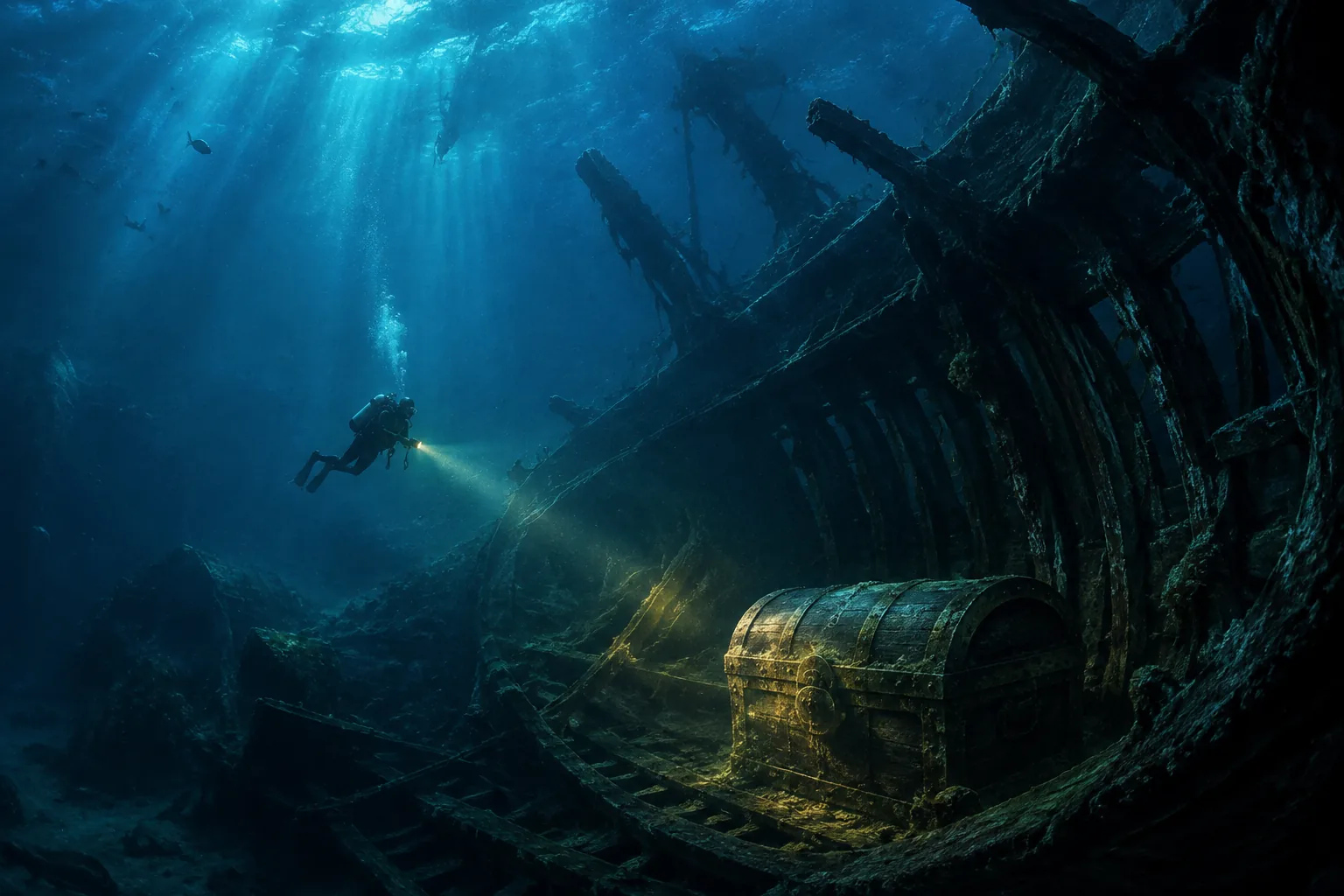
This story is a work of fiction with AI illustrations. Its characters and discoveries are imaginary.
This story is entirely fictional. In Lembayung Bay, every eclipse brings forth rows of towers on the seabed, in the very place where, on ordinary days, there is only silvery sand. Nira has been waiting for a chance to see them ever since she found her grandmother’s sketchbook, but a torn-out page has left her unaware of the city’s most important rule.
Steps at the Bottom of the Bay
Nira set off with her younger brother, Banu, in a small submarine called Kemiri. They had inherited the round vessel from their grandmother, along with a sketchbook filled with arched windows, shell gardens, and an unnamed square. As the eclipse’s shadow crept across the surface, the sand beneath Kemiri folded like cloth. A long staircase appeared, followed by faintly gleaming blue rooftops. Banu pressed his palm against the glass. In their grandmother’s drawing, the staircase ended at a door. Now the door was open.
They moored Kemiri to a seahorse-shaped post. Beyond the door lay a dry passage, as though the water stopped at an invisible curtain. Nira checked the mooring once more before going inside. The city was quiet, but not abandoned: brooms leaned outside houses, cups stood neatly arranged in a café, and a piece of ribbon still floated above a bench. Then came a soft tapping. A porcelain crab emerged from behind a pot, carrying a sign that read: Guests, follow the yellow lights.
The City That Kept Its Bearings
The crab’s name was Kelik, the temporary keeper of the City of Selaras. He spoke by rubbing his claws together, making a sound like a spoon touching a glass. According to him, Selaras took shape only during an eclipse. At all other times, its houses and streets became possibilities once more, held at the bottom of the bay. Its residents were gathering in the Hall of Directions to prepare for the city’s return. But one of the seven guiding lights was unlit. Without it, a neighborhood could lose its way when the city disappeared.
Nira opened her grandmother’s book. The drawing of the square turned out to show the same seven posts that stood before them. From the last post hung a round object resembling a bell. Kelik immediately hurried closer. That was the Homeward Lantern, he said, but it had moved to the Tidal Tower when the connecting bridge folded away. Banu spotted a leaning tower at the end of the street. At its top was a yellow light as small as a kernel of corn, while the staircase leading up to it ended in midair.
Kelik asked them to return to their submarine before the eclipse ended. Nira started to nod, then noticed a row of tiny houses behind the dark post. In one of the windows, a hand was straightening a curtain. Those houses were more than lines in a book. She asked whether there was another way to the tower. Kelik pointed to a mail delivery channel that was too narrow for the people of Selaras, but wide enough for two children and a porcelain crab.
The Undelivered Letter
They entered the channel in a delivery basket that traveled along rails. Banu turned the crank, Nira read the signs at the junctions, and Kelik tapped out directions with his claws. Halfway through, the rails broke off at a gap filled with shimmering water. The basket stopped abruptly. A long chime sounded from behind the wall, and then the first light in the distance began to dim. Nira nearly jumped out, but Banu held her back. He had spotted a lever hidden beneath a pile of mailbags.
The lever did not move the rails. Instead, a drawer opened, revealing a letter addressed to the Keeper After Me. Nira recognized the little drawing of Kemiri in the corner of the envelope. Her grandmother had written the letter. Its message was brief: if the bridge is gone, do not look for the old route; send a new one. Beneath the words was a drawing of a basket with a sail unfurled. Banu looked at the mailbags, then at the clothesline stretching across the channel. This time, he was the first to understand the clue.
A Lantern for Everyone
They joined the empty bags together to make a sail, attached it to the crank handle, and pulled the clothesline over to use as a guide. When Nira opened a vent in the wall, a warm gust filled the sail and lifted the basket across the gap. They landed at an angle on the tower’s balcony. The Homeward Lantern hung from a hook within easy reach, but its light grew smaller each time Nira approached. Beneath it was an inscription: What is taken to be owned will go dark. What is carried to be shared will shine.
Nira remembered her plan to bring something home from the city so that people would believe her grandmother’s drawings. Slowly, she closed her bag, then lifted the lantern with both hands. This time, its light held steady. They carried it back through the channel, down a street that was turning transparent, and hung it on the seventh post. Yellow light spread to every window. The doors of the Hall of Directions opened, and the residents hurried out toward their homes, waving to the three who had delivered the lantern.
Kelik accompanied them back to Kemiri. Before the city’s door closed, he handed them an empty envelope bearing a drawing of the submarine: an invitation to the next eclipse. Through the glass, Nira watched the towers and streets slowly fold into lines of light, then vanish beneath the silvery sand. She brought back no lantern, no porcelain fragment, and no stone from the square. Yet when Banu opened their grandmother’s book, the torn-out page was whole again. On it was a drawing of a basket under sail, with three small passengers crossing a gap.